

Woodward specialStarting at $149Drain ClearingNot valid with any other discounts or coupons.(503) 610-8948Click to turn over ↗(503) 610-8948Call to claim this coupon
4.9Based on 5,100+ Reviews
Water Purification Systems in Salem, OR
Improve your home’s water quality with water purification system installation in Salem, OR. Woodward installs whole-home and point-of-use systems.
Woodward expertise
Water Purification Systems
Better water starts with choosing a purification system that matches the water entering your home and what you want to improve. Woodward Plumbing provides professional water purification system installation in the Willamette Valley for homeowners looking to improve drinking water, reduce unwanted substances, or add additional treatment beyond the water supplied to the property.
Our plumbers can install whole-home water purification systems as well as point-of-use drinking water systems. The right approach depends on factors such as your water source, water-quality concerns, household usage, available space, plumbing configuration, and desired flow rate.
Homes connected to the Willamette Valley municipal water have different needs than properties supplied by a private well. Woodward can help you compare the appropriate treatment options without assuming that every home needs the same type of equipment.
Serving Oregon homeowners since 1989 | Oregon License #153836 | Whole-home & point-of-use water purification
Call (503) 610-8948 to discuss water purification system installation in the Willamette Valley.
Woodward Plumbing came out initially just to flush our water heater, but during the visit they noticed a couple of underlying issues that could have turned into bigger problems later. They took the time to explain everything in a way that made sense, walked me through the options, and handled the repairs right then and there. I really appreciated how thorough and proactive they were instead of just doing the basic service and leaving.
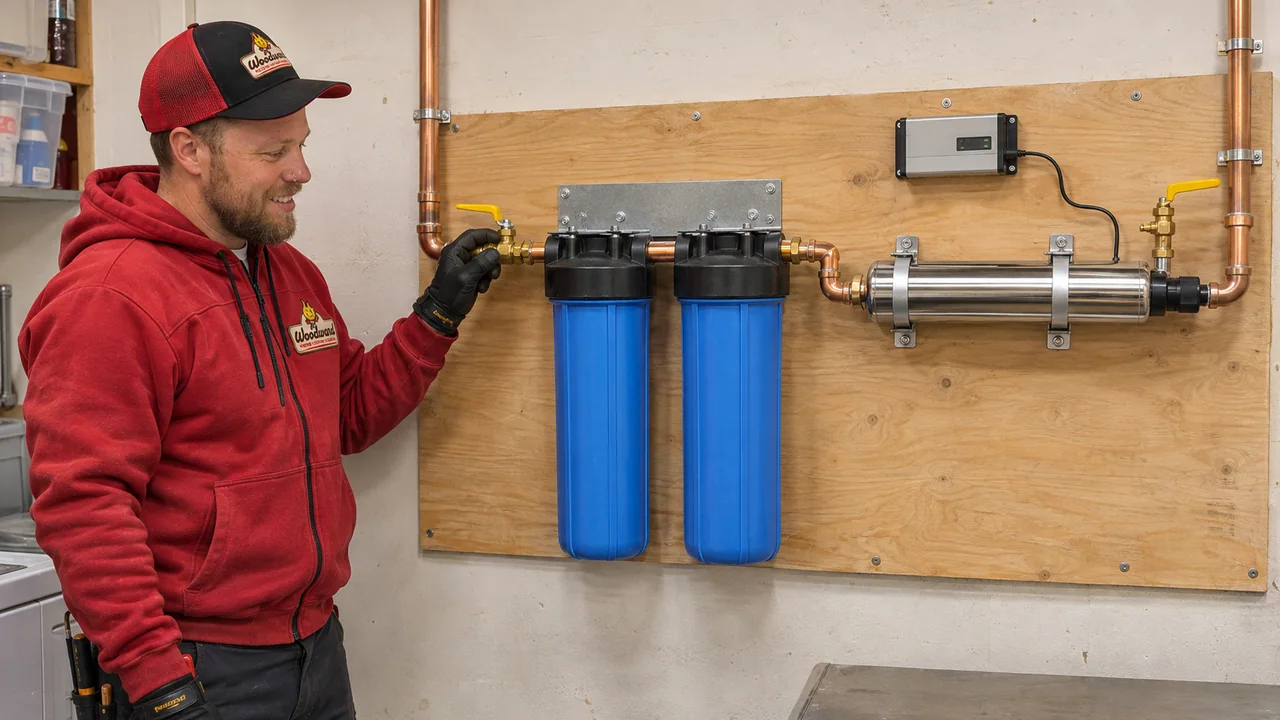
Whole-House vs. Point-of-Use Water Purification
One of the first decisions is how much of the home’s water you want to treat. Water purification systems can be installed at a single fixture or where the main water supply enters the home.
| System Type | Where It Treats Water | Common Goal |
|---|---|---|
| Point-of-use | A specific fixture, often a kitchen drinking-water faucet | Targeted drinking and cooking water treatment |
| Whole-home / point-of-entry | Main water line before water is distributed through the home | Treatment for water used throughout the plumbing system |
Water Purification for the Willamette Valley Municipal Water
the Willamette Valley’s municipal drinking water comes primarily from the North Santiam Watershed and is treated by the City before entering the distribution system. The City uses multiple treatment processes and continuously monitors water quality throughout the system.
An in-home purification system is therefore not automatically necessary for every the Willamette Valley residence. Some homeowners choose additional treatment to address taste, odor, sediment, a specific reduction goal, or personal preferences for drinking water.
Water Purification for Private Well Water
Private well owners have a different responsibility because the property’s water is not monitored like a municipal water supply. Laboratory testing can help identify what is actually present before treatment equipment is selected.
Oregon health officials commonly recommend testing private wells for contaminants such as arsenic, nitrate, and coliform bacteria. Other water-quality characteristics such as iron, hardness, calcium, magnesium, manganese, or sediment may also influence the type of treatment equipment used.
Visible, clear water does not necessarily identify its mineral content or tell you whether a specific contaminant is present. Choosing treatment around water-quality information is more reliable than choosing a system based only on taste or appearance.
Homeowners still determining what type of treatment they need can start with our broader water treatment services in the Willamette Valley.
Choosing the Best Water Purification System for Your Home
The best whole-house water purification system is not necessarily the system with the greatest number of filtration stages. The better choice is equipment designed for the water-quality issue you actually want to address while still providing adequate water pressure and flow for the household.
Common Water Purification Technologies
Review the water purification systems options and details below, or contact our team to discuss your property.
| Treatment Method | What It Is Commonly Used For |
|---|---|
| Sediment filtration | Capturing particles such as sand, dirt, rust, and other suspended material |
| Activated carbon | Reducing certain tastes, odors, chlorine, and other substances when the filter is certified for those reductions |
| Reverse osmosis | Reducing many dissolved substances at a drinking-water fixture, depending on the membrane and system certification |
| Ultraviolet treatment | Reducing microorganisms when properly designed and used with appropriate pretreatment |
| Water softening | Reducing hardness minerals such as calcium and magnesium |
Sediment & Carbon Filtration
Sediment filters are often used to capture particulate matter before it reaches later treatment stages. Carbon filtration can be used for particular taste, odor, chlorine, or contaminant-reduction goals depending on the type of media and the system’s certified performance.
Homeowners primarily interested in treating water throughout the house can learn more about our whole-house water filtration systems in the Willamette Valley.
Reverse Osmosis Drinking Water Systems
Reverse osmosis uses pressure to move water through a semipermeable membrane. RO systems can reduce a wide range of dissolved substances, but individual systems have different contaminant-reduction certifications. Point-of-use RO is commonly installed at a kitchen sink or another dedicated drinking-water location.
Explore our dedicated reverse osmosis systems in the Willamette Valley for more information about this type of drinking water treatment.
Hard Water Requires a Different Approach
Water purification and water softening are not interchangeable. Traditional water softeners are specifically designed to remove hardness minerals such as calcium and magnesium through ion exchange. A homeowner dealing primarily with scale or confirmed hard water may need a softener instead of, or alongside, another filtration system.
Flow Rate & Water Pressure Matter
Whole-home equipment must also be sized around household water demand. A system that is too restrictive for the home’s peak flow can contribute to noticeable pressure loss when several fixtures are operating at once.
The plumbing layout, pipe size, treatment media, equipment capacity, and expected household demand should all be considered during water purification system installation.
Plan for Maintenance From the Beginning
Water treatment equipment only performs as intended when it is maintained properly. Depending on the system, maintenance may involve replacing sediment or carbon filters, servicing treatment media, replacing an RO membrane, changing a UV lamp, or completing other manufacturer-recommended maintenance.
Filter life should be based on the specific equipment, water conditions, usage, and manufacturer guidance rather than a universal replacement schedule.
Halo 5
Review the water purification systems options and details below, or contact our team to discuss your property.
- High Capacity Filtration
- Enhanced Water Purity
- Reliable Operation
Install a Water Purification System in the Willamette Valley
Woodward Plumbing can help you compare whole-home and point-of-use water purification options based on your plumbing system, water source, household demand, and water-quality goals.
Our Willamette Valley water-quality services also include water softener systems and other plumbing services in the Willamette Valley.
Call (503) 610-8948 to schedule water purification system installation in the Willamette Valley.
Water Treatment Options
We offer HALO and Novo water treatment systems. Contact our team to discuss the right options for your home.
Let’s talk about your property
Request Service
Tell us what is happening at your property. Our team can discuss service options and confirm an available appointment.
Local service
Service Across the Willamette Valley
Our Salem team serves these communities, including Eugene. Explore your community or contact us to confirm service at your address.
- Salem
- Eugene
- Keizer
- Albany
- Corvallis
- Springfield
- Aumsville
- Dallas
- McMinnville
- Lebanon
- Stayton
- Monmouth
- Silverton
- Woodburn
- Wilsonville
- Independence
- Sublimity
- Amity
- Aurora
- Canby
- Crabtree
- Dayton
- Depoe Bay
- Donald
- Gates
- Gervais
- Hubbard
- Jefferson
- Lake Oswego
- Lincoln City
- Lowell
- Lyons
- Mehama
- Mill City
- Molalla
- Mount Angel
- Newport
- Pacific City
- Rickreall
- Saint Benedict
- Saint Paul
- Scio
- Scotts Mills
- Tangent
- Tigard
- Turner
- Detroit
- Sheridan
- Sweet Home
Helpful answers
Water Purification Systems in Salem, OR Questions
Find answers about service and arranging a visit. Call our team if you need help with your specific equipment or property.
What is the best whole-house water purification system?
The best system depends on the home’s water source and the substances or water-quality characteristics you want to address. Sediment, taste and odor, hardness, microorganisms, and dissolved contaminants can require different treatment technologies. Water-quality information and certified contaminant-reduction claims can help narrow the options.
Does the Willamette Valley city water need a purification system?
Not necessarily. The City of the Willamette Valley treats and monitors its municipal drinking water. Some homeowners still choose additional home treatment for taste, odor, sediment, specific reduction goals, or personal drinking-water preferences.
Should well water be tested before installing a purification system?
Yes. Laboratory testing is particularly useful for private wells because contaminants such as arsenic, nitrate, and coliform bacteria cannot reliably be identified by taste, smell, or appearance. Test results can help determine which treatment technology is appropriate.
Is a whole-house water filter the same as reverse osmosis?
No. Whole-house filtration generally treats water as it enters the home, while residential reverse osmosis is commonly used as a point-of-use system for drinking and cooking water. Each technology has different capabilities.
Does a water purification system soften hard water?
Not necessarily. Hard water is primarily caused by calcium and magnesium. Traditional water softener systems are designed specifically to reduce those hardness minerals. Some homes use both softening and filtration when more than one water-quality issue needs to be addressed.
Can a home purification system remove arsenic?
Some treatment systems can reduce arsenic, but not every filter is designed or certified to do so. The type and concentration of arsenic, other water characteristics, and the equipment’s certified reduction claims should be considered before selecting a system.
Will a whole-house water purification system reduce water pressure?
A properly selected system should be sized around the home’s expected flow rate. Undersized equipment, restrictive filters, or filters that have become clogged can affect water pressure, which is why proper sizing and regular maintenance are important.
How often does a water purification system need maintenance?
Maintenance intervals vary by system, water quality, household usage, and manufacturer recommendations. Filters, treatment media, RO membranes, and other components should be serviced or replaced according to the requirements of the installed equipment.
REQUEST SERVICE ONLINE
What service do you need help with?
4.9Based on 5,100+ Reviews
What Our Customers Say
Homeowners across Salem, Eugene, and neighboring communities share their experiences with Woodward.

“Woodward Heating, Air & Plumbing installed our new Daikin heat pump and furnace. The crew was extremely professional, polite, and left our home spotless. Highly recommend for any HVAC needs in Salem!”
“Called Woodward for an emergency furnace repair when our heating died on a freezing morning. They arrived within 2 hours, diagnosed a failed igniter, and had us warm again fast!”
“Fantastic service! We signed up for Woodward's $159 Precision Tune-Up. The technician was thorough, answered all my questions, and didn't push unnecessary upsells.”
“Woodward replaced our water heater and cleared a stubborn main line drain block. Honest upfront pricing and courteous Oregon technicians. 10/10 experience!”
“We had a Mitsubishi ductless mini-split system installed for our home office. The crew was efficient, neat, and the unit works flawlessly for both heating and AC.”
“Always reliable and trustworthy. Woodward has maintained our heating and cooling systems for over 10 years. Upfront quotes with no surprises ever.”
“Great experience working with Woodward. Their financing options made replacing our 20-year-old air conditioner manageable and stress-free.”
“Prompt, knowledgeable, and respectful of our home. They wore shoe covers and explained the whole air quality filtration setup clearly.”

“Best HVAC contractor in Marion County! Upfront pricing, licensed technicians, and friendly local service every single time.”
“Woodward installed a Lennox high-efficiency furnace before winter. Our monthly heating bills dropped immediately. Outstanding local team!”
“Friendly phone staff, rapid dispatch, and skilled technicians. Woodward is our go-to for both plumbing repairs and annual AC maintenance.”
“Shaq & Woody's team delivered 5-star service! They repaired our AC during a 95-degree heatwave on the same day we called.”
“Woodward replaced our water heater and cleared a stubborn main line drain block. Honest upfront pricing and courteous Oregon technicians. 10/10 experience!”
“We had a Mitsubishi ductless mini-split system installed for our home office. The crew was efficient, neat, and the unit works flawlessly for both heating and AC.”
“Woodward Heating, Air & Plumbing installed our new Daikin heat pump and furnace. The crew was extremely professional, polite, and left our home spotless. Highly recommend for any HVAC needs in Salem!”
“Best HVAC contractor in Marion County! Upfront pricing, licensed technicians, and friendly local service every single time.”
“Called Woodward for an emergency furnace repair when our heating died on a freezing morning. They arrived within 2 hours, diagnosed a failed igniter, and had us warm again fast!”
“Prompt, knowledgeable, and respectful of our home. They wore shoe covers and explained the whole air quality filtration setup clearly.”
How It Works
Tell us what is happening. Our team confirms the visit, and your technician walks you through the options.
1
Tell Us What You Need
Call or request service online with your location and the problem you need help with.
2
Confirm the Visit
Our team confirms your service needs, timing, and dispatch availability.
3
Review Your Options
Your technician explains the findings and proposed work before starting.
Current Specials & Flexible Financing
Woodward specialFREE DiagnosticWith HVAC RepairDiagnostic is free with repair.(503) 610-8948Click to turn over ↗(503) 610-8948Call to claim this coupon
Woodward special$30 OFFSeasonal Tune UpHeating or cooling seasonal tune up.(503) 610-8948Click to turn over ↗(503) 610-8948Call to claim this coupon
Woodward special0% for 18 MonthsFinancing on Select SystemsOn approved credit (OAC). Select systems only; subject to lender approval and terms.(503) 610-8948Click to turn over ↗(503) 610-8948Call to claim this coupon
Financing Options
Ask about monthly payment options for equipment replacement. Financing is subject to credit approval and lender terms.
