

Woodward specialStarting at $149Drain ClearingNot valid with any other discounts or coupons.(503) 610-8948Click to turn over ↗(503) 610-8948Call to claim this coupon
4.9Based on 5,100+ Reviews
Water Softener Systems in Salem, OR
Professional water softener installation in Salem, OR. Get a properly sized whole-home system to reduce hard water, mineral scale and buildup.
Woodward expertise
Water Softener Systems
Hard water can leave mineral scale on faucets and showerheads, create spots on dishes and glassware, reduce soap performance, and contribute to buildup throughout a home’s plumbing. Woodward Plumbing provides professional water softener installation in the Willamette Valley for homeowners who want to reduce calcium and magnesium hardness throughout the house.
Our plumbers install and replace whole-home water softener systems based on the home’s water hardness, household water usage, required flow rate, plumbing configuration, and available installation space.
A properly sized system treats hardness before softened water is distributed through the home’s plumbing, helping reduce the mineral deposits commonly associated with hard water.
Serving Oregon homeowners since 1989 | Oregon License #153836 | Whole-home water softener installation & replacement
Call (503) 610-8948 to discuss water softener installation in the Willamette Valley.
Woodward Plumbing came out initially just to flush our water heater, but during the visit they noticed a couple of underlying issues that could have turned into bigger problems later. They took the time to explain everything in a way that made sense, walked me through the options, and handled the repairs right then and there. I really appreciated how thorough and proactive they were instead of just doing the basic service and leaving.
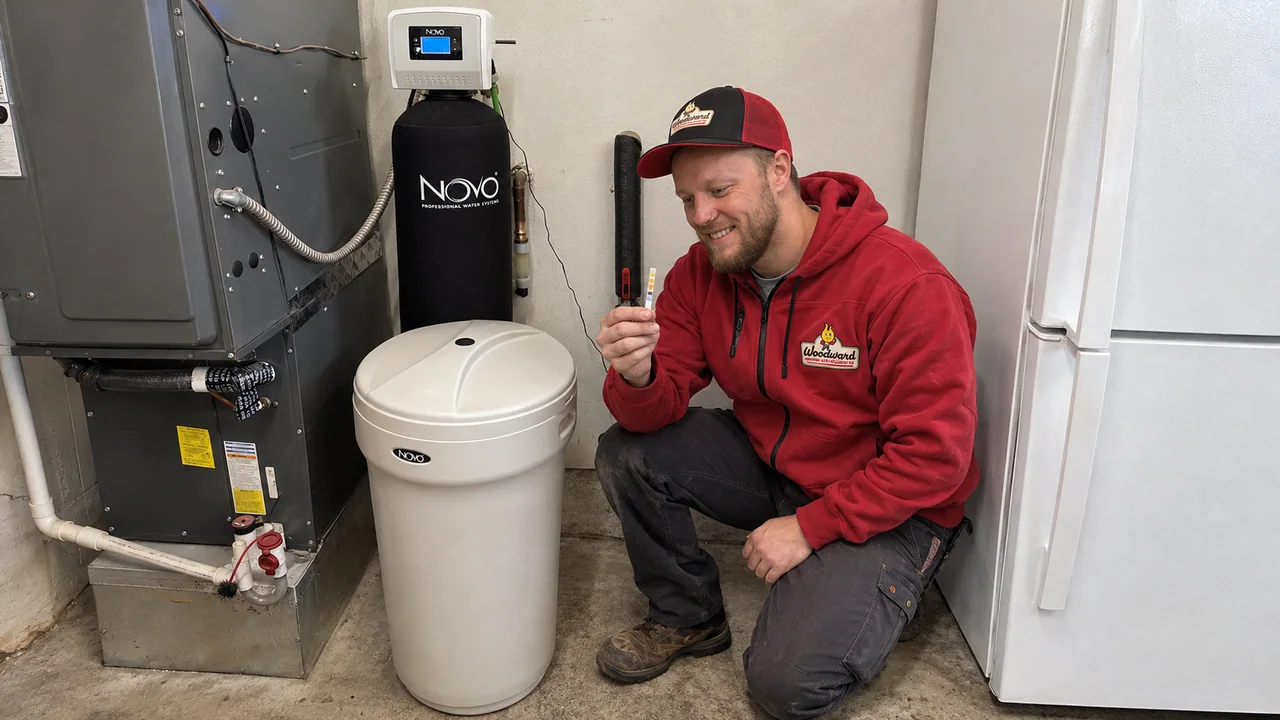
Signs Your Willamette Valley Home May Have Hard Water
Water hardness is caused primarily by dissolved calcium and magnesium. As water moves through the plumbing system, those minerals can leave deposits on fixtures, glass, plumbing components, and water-using equipment.
Hardness is commonly measured in grains per gallon (GPG) or parts per million. Testing the incoming water can provide a clearer picture of the hardness level and help determine how much softening capacity the household needs.
Common Hard Water Problems
Review the water softener systems options and details below, or contact our team to discuss your property.
- White or chalky scale around faucets
- Mineral buildup on showerheads
- Water spots on dishes and glassware
- Residue on shower doors and tile
- Soap or shampoo that does not lather easily
- Recurring buildup on plumbing fixtures
- Mineral deposits in water-using appliances
- Stiff or residue-covered laundry
How a Whole-House Water Softener Works
Traditional water softener systems commonly use ion exchange. Hard water passes through a resin bed where calcium and magnesium ions are exchanged for sodium or potassium ions before the treated water continues through the home’s plumbing.
The resin periodically needs to regenerate so it can continue reducing hardness. Salt-based systems use a brine solution during this process, which refreshes the resin and carries the captured hardness minerals out of the system.
Water Softener vs. Water Filter
A water softener and a whole-house water filter perform different jobs. Water softeners are designed specifically around calcium, magnesium, and water hardness, while filtration systems are selected for other water-quality concerns such as sediment, taste, odor, or particular substances.
Homeowners comparing the two can read our guide to water softeners vs. whole-house water filters.
Professional Water Softener Installation in the Willamette Valley
Choosing the equipment is only one part of a successful water softener installation. The system also needs enough capacity and flow for the household, an appropriate connection to the plumbing system, access to required drainage, and a location that allows future maintenance.
How We Size a Whole-Home Water Softener
Water softener sizing should account for more than the number of people living in the home. Woodward considers factors such as:
- Incoming water hardness
- Household size
- Typical daily water usage
- Required flow rate
- System capacity
- Expected regeneration frequency
- Existing plumbing configuration
- Available installation and drainage space
A system that is undersized may regenerate too frequently or struggle during periods of high water usage. An unnecessarily large system can add cost without providing a meaningful benefit.
What Happens During Installation?
Review the water softener systems options and details below, or contact our team to discuss your property.
| Before Installation | Installation & Setup |
|---|---|
| Evaluate water-softening needs | Position the new equipment |
| Review hardness and household demand | Connect it to the appropriate water piping |
| Determine capacity and flow requirements | Configure the bypass connection as needed |
| Inspect available installation space | Connect regeneration drainage where applicable |
| Review existing plumbing | Configure and check system operation |
Water Softener Replacement & Repair
An existing water softener does not automatically need replacement because performance has declined. Controls, valves, regeneration problems, salt bridging, and other system issues may sometimes be repairable depending on the equipment and its condition.
Replacement may make more sense when a system is deteriorated, repeatedly requires repairs, no longer provides enough softened water, or is poorly sized for the home’s current water usage.
Woodward can evaluate the existing equipment and help determine whether water softener repair or replacement is the more practical next step.
Water Softener Maintenance
Salt-based water softeners require periodic salt replenishment and other maintenance specified by the equipment manufacturer. Water hardness, household usage, system settings, and equipment design can all affect maintenance needs.
For detailed maintenance guidance, see our water softener maintenance guide.
Halo 5
Review the water softener systems options and details below, or contact our team to discuss your property.
- High Capacity Filtration
- Enhanced Water Purity
- Reliable Operation
Schedule Water Softener Installation in the Willamette Valley
Woodward Plumbing has served the Willamette Valley-area homeowners since 1989. Our plumbers can help evaluate hard water, properly size a whole-home softener, replace older equipment, and professionally integrate the system with your home’s plumbing.
Homeowners with broader water-quality concerns can also explore our water treatment services in the Willamette Valley or our complete range of the Willamette Valley plumbing services.
Call (503) 610-8948 to discuss water softener installation in the Willamette Valley.
Water Treatment Options
We offer HALO and Novo water treatment systems. Contact our team to discuss the right options for your home.
Let’s talk about your property
Request Service
Tell us what is happening at your property. Our team can discuss service options and confirm an available appointment.
Local service
Service Across the Willamette Valley
Our Salem team serves these communities, including Eugene. Explore your community or contact us to confirm service at your address.
- Salem
- Eugene
- Keizer
- Albany
- Corvallis
- Springfield
- Aumsville
- Dallas
- McMinnville
- Lebanon
- Stayton
- Monmouth
- Silverton
- Woodburn
- Wilsonville
- Independence
- Sublimity
- Amity
- Aurora
- Canby
- Crabtree
- Dayton
- Depoe Bay
- Donald
- Gates
- Gervais
- Hubbard
- Jefferson
- Lake Oswego
- Lincoln City
- Lowell
- Lyons
- Mehama
- Mill City
- Molalla
- Mount Angel
- Newport
- Pacific City
- Rickreall
- Saint Benedict
- Saint Paul
- Scio
- Scotts Mills
- Tangent
- Tigard
- Turner
- Detroit
- Sheridan
- Sweet Home
Helpful answers
Water Softener Systems in Salem, OR Questions
Find answers about service and arranging a visit. Call our team if you need help with your specific equipment or property.
What Affects the Cost of a Water Softener Installation?
Water softener installation costs vary because the equipment and plumbing requirements differ from one home to another. The goal is to select a system around the home’s actual hardness and water demand rather than choosing solely by price or advertised capacity. Water hardness level Household size and typical water usage Required system capacity Desired flow rate Type of water softener Existing plumbing configuration Installation location and accessibility Drain and utility requirements Removal of an existing system Additional plumbing modifications Woodward Plumbing evaluates the installation requirements before providing project pricing. Financing options are available for qualifying plumbing projects.
How do I know if my the Willamette Valley home needs a water softener?
Mineral scale around faucets and showerheads, spots on dishes, residue on shower doors, poor soap lather, and recurring mineral buildup can all indicate hard water. Measuring the hardness of the incoming water provides more useful information when deciding whether a softener is appropriate.
What size water softener does my home need?
System sizing depends on water hardness, household water usage, required flow rate, softener capacity, and regeneration frequency. Household size alone is not enough to determine the proper capacity.
Where is a whole-house water softener installed?
A whole-home water softener is generally connected near the point where the main water line enters the home’s plumbing so hardness can be reduced before treated water reaches the appropriate fixtures and water-using equipment.
Is a water softener the same as a water conditioner?
Not always. Traditional water softeners use ion exchange to reduce calcium and magnesium hardness. Products marketed as water conditioners may use different technologies and may not actually remove hardness minerals. The equipment should be selected according to the water-quality goal.
Is a water softener the same as a whole-house water filter?
No. Water softeners primarily address calcium and magnesium hardness. Whole-house water filtration systems are designed around other water-quality concerns. Some homes may use both types of treatment.
Can Woodward replace an existing water softener?
Yes. Woodward Plumbing can evaluate an existing system and determine whether repair or replacement makes more sense based on its condition, performance, capacity, repair history, and the household’s current needs.
Can a water softener help reduce scale around a water heater?
Reducing calcium and magnesium hardness can reduce the amount of hardness mineral entering water-using equipment. A water softener does not replace normal water heater maintenance, but controlling hardness can help limit scale associated with hard water.
How often does a water softener need maintenance?
Maintenance depends on the system, water hardness, household usage, and manufacturer recommendations. Salt-based systems generally require periodic salt replenishment along with other equipment-specific maintenance.
REQUEST SERVICE ONLINE
What service do you need help with?
4.9Based on 5,100+ Reviews
What Our Customers Say
Homeowners across Salem, Eugene, and neighboring communities share their experiences with Woodward.

“Woodward Heating, Air & Plumbing installed our new Daikin heat pump and furnace. The crew was extremely professional, polite, and left our home spotless. Highly recommend for any HVAC needs in Salem!”
“Called Woodward for an emergency furnace repair when our heating died on a freezing morning. They arrived within 2 hours, diagnosed a failed igniter, and had us warm again fast!”
“Fantastic service! We signed up for Woodward's $159 Precision Tune-Up. The technician was thorough, answered all my questions, and didn't push unnecessary upsells.”
“Woodward replaced our water heater and cleared a stubborn main line drain block. Honest upfront pricing and courteous Oregon technicians. 10/10 experience!”
“We had a Mitsubishi ductless mini-split system installed for our home office. The crew was efficient, neat, and the unit works flawlessly for both heating and AC.”
“Always reliable and trustworthy. Woodward has maintained our heating and cooling systems for over 10 years. Upfront quotes with no surprises ever.”
“Great experience working with Woodward. Their financing options made replacing our 20-year-old air conditioner manageable and stress-free.”
“Prompt, knowledgeable, and respectful of our home. They wore shoe covers and explained the whole air quality filtration setup clearly.”

“Best HVAC contractor in Marion County! Upfront pricing, licensed technicians, and friendly local service every single time.”
“Woodward installed a Lennox high-efficiency furnace before winter. Our monthly heating bills dropped immediately. Outstanding local team!”
“Friendly phone staff, rapid dispatch, and skilled technicians. Woodward is our go-to for both plumbing repairs and annual AC maintenance.”
“Shaq & Woody's team delivered 5-star service! They repaired our AC during a 95-degree heatwave on the same day we called.”
“Woodward replaced our water heater and cleared a stubborn main line drain block. Honest upfront pricing and courteous Oregon technicians. 10/10 experience!”
“We had a Mitsubishi ductless mini-split system installed for our home office. The crew was efficient, neat, and the unit works flawlessly for both heating and AC.”
“Woodward Heating, Air & Plumbing installed our new Daikin heat pump and furnace. The crew was extremely professional, polite, and left our home spotless. Highly recommend for any HVAC needs in Salem!”
“Best HVAC contractor in Marion County! Upfront pricing, licensed technicians, and friendly local service every single time.”
“Called Woodward for an emergency furnace repair when our heating died on a freezing morning. They arrived within 2 hours, diagnosed a failed igniter, and had us warm again fast!”
“Prompt, knowledgeable, and respectful of our home. They wore shoe covers and explained the whole air quality filtration setup clearly.”
How It Works
Tell us what is happening. Our team confirms the visit, and your technician walks you through the options.
1
Tell Us What You Need
Call or request service online with your location and the problem you need help with.
2
Confirm the Visit
Our team confirms your service needs, timing, and dispatch availability.
3
Review Your Options
Your technician explains the findings and proposed work before starting.
Current Specials & Flexible Financing
Woodward specialFREE DiagnosticWith HVAC RepairDiagnostic is free with repair.(503) 610-8948Click to turn over ↗(503) 610-8948Call to claim this coupon
Woodward special$30 OFFSeasonal Tune UpHeating or cooling seasonal tune up.(503) 610-8948Click to turn over ↗(503) 610-8948Call to claim this coupon
Woodward special0% for 18 MonthsFinancing on Select SystemsOn approved credit (OAC). Select systems only; subject to lender approval and terms.(503) 610-8948Click to turn over ↗(503) 610-8948Call to claim this coupon
Financing Options
Ask about monthly payment options for equipment replacement. Financing is subject to credit approval and lender terms.
